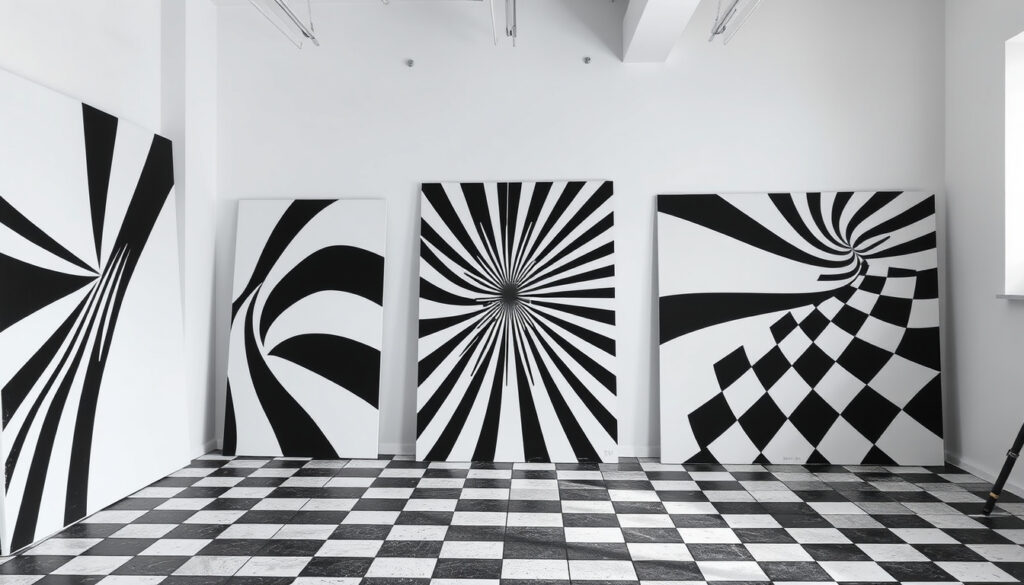
Bridget Riley Artist: Op Art Pioneer and Biography
Few artists have managed to trick the eye as deliberately as Bridget Riley. This article traces her journey from a figurative painter to the leading figure of Op Art, examining the techniques behind her most famous works, her career milestones, and what her paintings actually sell for today.
Born: 24 April 1931 ·
Nationality: British ·
Known For: Op Art ·
Most Famous Work: Movement in Squares (1961) ·
Auction Record: £4,362,000 (Christie’s) ·
Status: Alive
Quick snapshot
- Born in London on 24 April 1931 (Britannica (encyclopedic reference))
- Studied at Goldsmiths College and the Royal College of Art (Cristea Roberts Gallery (artist representative))
- Breakthrough work Movement in Squares (1961) (Tate (national museum))
- Alive and still active (David Zwirner (gallery representation))
- Exact total number of works produced
- Personal relationships (no known marriage)
- Future exhibition schedule
- Collaboration with architect Peter Cook (unconfirmed)
- 1931 – Born in London (Britannica (encyclopedic reference))
- 1949–1955 – Studies at Goldsmiths College and Royal College of Art (Cristea Roberts Gallery (artist representative))
- 1961 – Paints Movement in Squares (Tate (national museum))
- 1968 – Wins International Painting Prize at Venice Biennale (Unit London (gallery))
- Continued gallery representation by David Zwirner and Cristea Roberts
- Increasing auction demand; record of £4.36 million
- Possible touring exhibitions (unconfirmed)
Seven key facts that define the artist at a glance:
| Attribute | Value |
|---|---|
| Full Name | Bridget Louise Riley |
| Born | 24 April 1931 |
| Nationality | British |
| Art Movement | Op Art |
| Education | Goldsmiths College, Royal College of Art |
| Known For | Optical illusion paintings |
| Status | Alive |
Riley’s career spans seven decades, yet her disciplined, mathematical approach keeps the work consistent and instantly recognisable. The scarcity of early pieces drives prices upward.
Who is the artist Bridget Riley?
Early life and education
- Bridget Louise Riley was born in Norwood, South London, on 24 April 1931 (Britannica (encyclopedic reference)). Her father was a printer, a background that may have influenced her later precision with patterns (Op-Art.co.uk (dedicated Op Art resource)).
- She studied at Goldsmiths College from 1949 to 1952, then at the Royal College of Art from 1952 to 1955 (Cristea Roberts Gallery (artist representative)).
Career milestones
- Riley began developing her Op Art style around 1960, soon focusing exclusively on simple geometric forms such as lines, circles, curves, and squares (David Zwirner (gallery representation)).
- Her breakthrough came in 1961 with Movement in Squares, exhibited widely and now held by the Tate collection (Tate (national museum)).
- In 1965 she was included in MoMA’s seminal exhibition The Responsive Eye, which introduced Op Art to a global audience.
- In 1968 she won the International Painting Prize at the Venice Biennale – the first woman to receive that honour (Unit London (gallery)).
- Major retrospectives followed: at Tate Britain in 2003 and the Musée d’Art Moderne de la Ville de Paris in 2008 (National Museum of Women in the Arts (museum)).
Personal life and current status
Riley has never married and keeps her private life largely out of the public eye. She is alive as of 2025 and continues to work from studios in London, Cornwall, and the Vaucluse region of France (David Zwirner (gallery representation)).
The implication: Riley’s long, uninterrupted career – combined with her refusal to chase trends – has built a legacy that feels both disciplined and rare.
What style of art is Bridget Riley known for?
What is Op Art?
- Op Art (short for Optical Art) emerged in the mid-1960s, using geometric abstraction to create illusions of movement, vibration, and afterimages.
- The Tate (national museum) states that Riley’s works “explore the dynamic potentialities of optical phenomena.”
- Riley is widely considered the movement’s most famous British practitioner (Tate (national museum)).
Op Art’s commercial peak in the 1960s faded, but Riley’s personal brand has remained strong because she refused to dilute her methods for market trends.
Characteristics of Riley’s style
- Her early works are strictly black and white, arranged in grids, stripes, and undulating patterns that trick the eye.
- She exploits simultaneous contrast and afterimages – the visual effects that occur when the retina sends conflicting signals.
- Each painting is meticulously planned: the spacing of lines or squares is calculated to produce exactly the desired flicker or swell.
Evolution from black and white to color
- From the 1970s onward, Riley introduced color, moving from early studies in black and white to vibrant combinations of red, blue, yellow, and green.
- She uses colour to create different perceptual layers – some hues advance, others recede, generating a sense of depth without any figurative subject.
- Her later striped paintings, such as the Nataraja series, demonstrate this chromatic sophistication.
The pattern: Riley’s style is often described as systematic and precise – she is a technician of vision, not an expressionist. That discipline makes her work instantly identifiable and hard to replicate.
What is Bridget Riley’s most famous piece of art?
Movement in Squares (1961)
- Widely regarded as her breakthrough work, Movement in Squares depicts a grid of squares that gradually change size, creating a flickering, swelling sensation.
- It was completed in 1961 and is now part of the Tate collection (Tate (national museum)).
- The painting exemplifies how minimal variation in shape can produce a powerful optical illusion.
Blaze (1964)
- Another iconic Op Art piece, Blaze uses concentric circles divided into radiating segments that appear to spin.
- It was featured in The Responsive Eye exhibition at MoMA and helped cement Riley’s international reputation.
Fall (1963)
- Fall uses a repeating pattern of wavy black-and-white lines that create a sensation of rippling movement.
- Tate describes Fall (1963) as one of her key Op Art works (Tate (national museum)).
Why this matters: Each of these three paintings represents a different formal problem – squares, circles, waves – and solves it with a distinct optical trick. They are the canon that any collector or student encounters first.
What techniques did Bridget Riley use in her art?
Geometric patterns and repetition
- Riley uses precise geometric shapes – squares, circles, curves, lines – arranged in grids or repeated sequences.
- Since 1961 she has focused exclusively on such forms, according to David Zwirner (gallery representation).
Black-and-white contrast
- Her early palette is limited to black and white, exploiting the maximum tonal difference to trigger retinal afterimages.
- The juxtaposition of black and white shapes creates the illusion of grey borders, a phenomenon known as simultaneous contrast.
Color theory and optical mixing
- When she introduced colour, Riley studied how adjacent hues influence each other. She uses complementary colours to intensify vibration.
- Small colour variations across a field can make a flat surface appear to curve or pulse.
Systematic and mathematical approach
- Riley plans each painting with precise spacing calculations, often working out the geometry on paper before any paint is applied.
- She works with a team of assistants to execute large-scale canvases, but the compositional decisions are entirely her own.
Riley’s methodical process means each piece takes weeks or months to complete – which limits output and pushes up prices on the secondary market. Buyers pay for both the artist’s name and the painstaking labour behind every square inch.
The implication: Riley’s meticulous preparation and limited output ensure that each work is a singular achievement, reinforcing her status as a master of optical art.
How much is a Bridget Riley painting?
Auction prices and records
- Riley’s works typically sell for amounts ranging from tens of thousands to several million dollars.
- Her current auction record is £4,362,000 (approximately $5.5 million) set at Christie’s in 2023 for an untitled 1960s painting (Christie’s (major auction house)).
- Another source, Artsy (art marketplace), lists her high auction record at £4.3 million, while MyArtBroker (secondary market platform) reports £4.4 million for the painting Gala.
Factors affecting value
- Provenance: paintings with exhibition history from major museums command higher bids.
- Period: early black-and-white works (1960s) are generally more valuable than later colour pieces.
- Size: larger canvases often sell for more, but not always – rarity of pattern matters.
- Market demand: Riley’s market is buoyant, with strong competition from private collectors and institutions.
Where to buy or sell
- Major auction houses Christie’s and Sotheby’s handle the highest-value sales.
- Galleries such as David Zwirner and Cristea Roberts represent her estate and also offer secondary-market pieces.
- Online platforms like Artsy and MyArtBroker provide price transparency and listing access.
The trade-off for buyers: early black-and-white works are the most desirable but also the most expensive and rarest. A collector on a tighter budget might target later colour works, which are still optically arresting but trade at a fraction of the price.
Timeline signal
- – Bridget Riley born in London.
- – Studies at Goldsmiths College and Royal College of Art.
- – Begins creating black-and-white Op Art works.
- – Paints Movement in Squares, her breakthrough piece.
- – Creates Blaze, another iconic Op Art painting.
- – Included in The Responsive Eye exhibition at MoMA.
- – Wins the International Painting Prize at the Venice Biennale – first woman recipient.
- – Transitions to colour-based optical works.
- – Tate Britain retrospective.
- – Retrospective at Musée d’Art Moderne de la Ville de Paris.
- – Still active; recent exhibition at the Morgan Library & Museum.
Clarity check
Confirmed facts
- Birth date and place: 24 April 1931, London (Britannica (encyclopedic reference))
- Education: Goldsmiths College (1949–1952), Royal College of Art (1952–1955) (Cristea Roberts Gallery (artist representative))
- Key artworks and dates: Movement in Squares (1961), Blaze (1964), Fall (1963) (Tate (national museum))
- Auction record: £4,362,000 at Christie’s (Christie’s (major auction house))
- Current status: alive and active (David Zwirner (gallery representation))
What’s unclear
- Exact number of works produced over her career
- Personal relationships (no known marriage or public partnerships)
- Future planned exhibitions (no official announcements as of early 2025)
In her own words and others’
“I want to create a visual experience that is entirely abstract and engages the viewer’s perception.”
Bridget Riley, in an interview cited by Tate (national museum)
“Riley’s work is about the dynamic potentialities of optical phenomena – it makes you see the act of seeing itself.”
Tate biography (Tate (national museum))
For collectors, the opportunity is clear: Bridget Riley’s market is supported by institutional validation, limited supply, and a seven-decade track record of rigorous technique. The early black-and-white works are the crown jewels, but later colour pieces offer a more accessible entry point into the op art pioneer’s legacy. For art students, her methodical approach stands as a practical blueprint for how systematic geometry can create genuine perceptual magic.
Frequently asked questions
Is Bridget Riley still alive?
Where was Bridget Riley born?
What awards has Bridget Riley won?
How did Bridget Riley’s style evolve over time?
What materials does Bridget Riley use?
Where can I see Bridget Riley’s work?
Did Bridget Riley have any famous collaborators?
More related posts
 DWP Cost of Living Payment 2025 May – No Payments Planned, Alternatives
 Where Is Ridley Set – Northern England Filming Locations
 Lloyds Pharmacy Near Me: UK Rebrand & Irish Locations
 Tranexamic Acid Side Effects – Risks, Symptoms and Safety Guide
 Rebecca Hall: Biography, Partner, Children, Net Worth & More
 The 1% Club – Format, Questions and Key Facts
 Carlos Sainz Jr.: Ferrari Exit, Expensive Poo Fine
 Is Difficulty Swallowing a Sign of Cancer – Symptoms and Red Flags