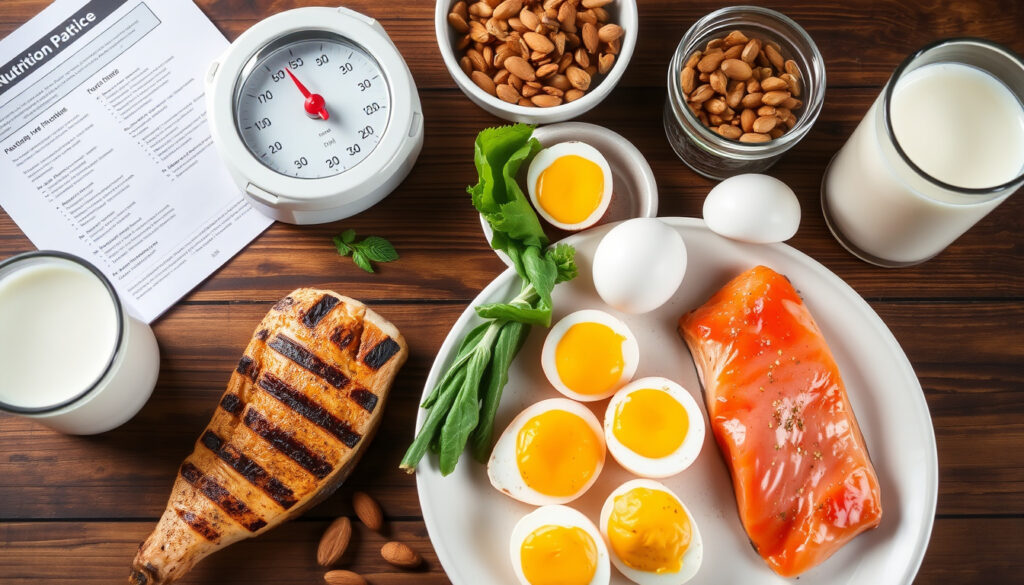
How Much Protein Should I Eat? Your Daily Protein Guide
If you’ve ever typed “how much protein should I eat” into a search bar, you already know the answer isn’t simple. This guide walks through personalized protein targets based on your activity level, goals, and life stage — moving beyond the one-size-fits-all RDA so you can stop guessing and start planning.
RDA for sedentary adults: 0.8 g per kg of body weight ·
Active adults range: 1.2–2.0 g per kg ·
Muscle building target: 1.6–2.2 g per kg ·
Protein in one large egg: 6–7 g
Quick snapshot
- RDA: 0.8 g/kg body weight (Harvard Health)
- Range: 1.2–1.7 g/kg (PTPioneer)
- Optimal: 1.6–2.2 g/kg (Promix Nutrition)
- Higher protein (1.2–1.6 g/kg) helps preserve muscle (Holland & Barrett)
Six key numbers capture the full protein landscape — from the minimum to the maximum, with real-world food examples:
| Category | Value |
|---|---|
| RDA (minimum requirement) | 0.8 g per kg body weight |
| Active/muscle maintenance | 1.2–1.7 g per kg |
| Muscle building range | 1.6–2.2 g per kg |
| Upper limit (potential excess) | >2.0 g per kg |
| Protein per large egg | 6–7 g |
| Protein per chicken breast (85 g) | approximately 26 g |
How should I calculate how much protein I need?
Your body weight is the starting point, but activity level, age, and health status shift the target. The basic formula: multiply your weight in kilograms by a factor between 0.8 and 2.2.
How much protein does a 70 kg person need?
- Sedentary: 56 g per day (0.8 g/kg) – Mayo Clinic Health System
- Active: 84–119 g per day (1.2–1.7 g/kg) – Calculator.net
- Muscle building: 112–154 g per day (1.6–2.2 g/kg) – Stanford Medicine
The catch: a 70 kg person following the RDA alone would get only about 10% of daily calories from protein if active – well below what most people need for recovery.
How much protein should I eat per meal?
- Target 20–40 g per meal to maximize muscle protein synthesis – Harvard Health
- Spreading intake across 3–5 meals supports steady amino acid delivery
Why this matters: a single large dose doesn’t work as well as even distribution throughout the day.
How much protein should I eat a day to lose weight?
- Aim for 1.2–1.6 g/kg to preserve lean mass while in a calorie deficit – Harvard Health
- Higher protein increases satiety and helps control appetite
The trade-off: going above 2.0 g/kg without medical supervision can strain kidneys over time.
How much protein should I eat a day to gain weight?
- For healthy weight gain, combine a calorie surplus with 1.6–2.2 g/kg protein – Promix Nutrition
- Focus on whole food sources like chicken, eggs, dairy, and legumes
The pattern: muscle gain and weight gain both demand the same protein ceiling; extra calories come from carbs and fats.
How much protein to build muscle?
The evidence converges on 1.6–2.2 g/kg as the sweet spot for muscle growth. Below that, gains slow; above, you risk excess without extra benefit.
How much protein should I eat as a male?
- Same per-kg range applies: 1.6–2.2 g/kg – Promix Nutrition
- Average US man already consumes about 100 g per day – Harvard Health
What this means: most men eating a standard American diet already meet their muscle-building target without supplements.
How much protein should I eat as a female?
- Women need the same grams per kilogram as men – gender differences are minimal relative to body size – Harvard Health
- Pregnancy increases needs: experts recommend 75–100 g per day – Harvard Health
Is 2 eggs a day enough protein?
- Two large eggs provide 12–14 g of protein – far below the 20–40 g per meal target for muscle building
- They’re a great start but need to be part of a larger meal
The trade-off: eggs are a complete protein, but you’d need 5–6 eggs per meal to hit the optimal post-workout window.
A 70 kg female lifter aiming for muscle gain needs roughly 112–154 g of protein per day — equivalent to about 16–22 eggs. That’s why variety matters: chicken, fish, dairy, and plant proteins fill the gap.
The implication: relying on eggs alone would require impractical amounts; mix sources for feasibility.
Is 100 g of protein a day too much?
For a sedentary 70 kg person, 100 g is 1.4 g/kg — above the RDA but within the safe range. For an active person, it’s right on target.
Is 200g of protein a day too much?
- 200 g for a 70 kg person equals 2.86 g/kg – well above the 2.0 g/kg upper limit – Harvard Health
- Long-term safety at this level is unclear for healthy individuals
The implication: unless you’re a large (100+ kg) athlete or under medical supervision, 200 g daily is excessive and may cause digestive stress.
What are the signs of too much protein?
- Digestive issues (bloating, constipation) – reported by users of high-protein diets
- Dehydration – protein metabolism increases water needs
- Weight gain – excess protein is stored as fat if calories exceed needs
Why this matters: if you experience these symptoms, reduce intake toward 1.6 g/kg and increase water.
People with pre-existing kidney conditions should consult a doctor before exceeding 1.2 g/kg — protein loads can accelerate kidney decline.
The catch: kidney health is a limiting factor for high protein intakes.
What is the 50 30 20 protein rule?
The 50/30/20 rule suggests getting 20% of daily calories from protein, 30% from fat, and 50% from carbohydrates. It’s a handy macro split but not a protein prescription.
What is the 3 3 3 rule for eating?
- 3 meals, 3 snacks, 3 hours apart – a structure for spreading calories evenly
- Not evidence-based for everyone, but helpful for some – Holland & Barrett
The catch: these rules are general guidelines, not personalized — they ignore body weight and activity level entirely.
How many eggs make 50g of protein?
One large egg contains 6–7 g of protein. To get 50 g, you need 7–8 eggs.
Is 2 eggs a day enough protein?
- 2 eggs = 12–14 g, which meets only about 12–18% of a 70 kg person’s RDA
- They are a complete protein (all essential amino acids) but insufficient as a sole source
The pattern: eggs are a building block, not the whole wall. Pair them with Greek yogurt, beans, or chicken for a complete meal.
Eggs are often called “nature’s multivitamin,” yet two eggs supply only a fraction of daily protein needs. The average person would need a dozen eggs to hit 75 g — that’s 1,000+ calories and 24 g of fat.
The pattern: eggs are nutritious but insufficient as a sole protein source.
How to calculate your personal protein needs: a step-by-step guide
- Weigh yourself in kilograms (divide pounds by 2.2).
- Choose your activity factor: sedentary (0.8), lightly active (1.2), moderately active (1.5), very active (1.8), muscle-building (2.0).
- Multiply weight × factor = daily protein target in grams.
- Distribute across meals: aim for 20–40 g per meal using foods like chicken (26 g per 85 g), eggs (6–7 g each), Greek yogurt (15 g per cup), or tofu (10 g per half cup).
- Adjust for special needs: pregnancy (+25 g per day), older adults (1.0–1.2 g/kg), recovery from illness (up to 1.5 g/kg).
The upshot: these steps give you a personalized target that adapts to your lifestyle.
What we know and what we don’t
Confirmed facts
- RDA of 0.8 g/kg prevents deficiency in sedentary adults (Harvard Health)
- Protein intakes up to 2.0 g/kg are generally safe for healthy individuals (Holland & Barrett)
- Higher protein supports muscle protein synthesis and satiety (PTPioneer)
What’s unclear
- Exact optimal protein for elderly individuals to combat sarcopenia
- Long-term safety of intakes >2.5 g/kg in athletic populations
- Ideal protein distribution across meals for maximum muscle growth
The conclusion: protein needs are individual, but the evidence base is strong for most ranges.
“The recommended dietary allowance to prevent deficiency for an average sedentary adult is 0.8 grams per kilogram of body weight.”
Mayo Clinic Health System
“Adult men in the U.S. are eating around 90 to 100 grams of protein a day.”
Stanford Medicine
“For an adult with a healthy weight, the recommended daily amount of protein is 0.75g per kg of body weight per day.”
British Heart Foundation
Your protein target isn’t a fixed number — it’s a sliding scale based on what your body demands. Ignore the one-size-fits-all RDA if you’re active, older, or recovering from illness. For the average reader in the US, the choice is clear: calculate your own grams per kilogram, prioritize whole food sources, and stay below 2.0 g/kg unless a dietitian advises otherwise.
Related reading: 11 Stone in Pounds: Weight Conversion Guide · Is Coffee Good for You? Benefits and Risks
Frequently asked questions
Is it safe to eat more than 2 g of protein per kg of body weight?
For healthy individuals, short-term intakes up to 2.5 g/kg appear safe, but long-term safety lacks evidence. People with kidney issues should consult a doctor.
What are the best animal and plant sources of protein?
Animal: chicken breast (26 g per 85 g), eggs (6–7 g each), Greek yogurt (15 g per cup). Plant: lentils (18 g per cup cooked), tofu (10 g per half cup), quinoa (8 g per cup cooked).
Can eating more protein help with belly fat loss?
Higher protein increases satiety and thermogenesis, which can support overall fat loss, but spot reduction is a myth. Protein alone won’t target belly fat.
Should I take protein supplements if I exercise regularly?
Supplements are convenient but not necessary. Whole foods can meet needs; aim for 20–40 g post-workout, which can come from a chicken breast or a shake.
How does age affect protein requirements?
Older adults (65+) may need 1.0–1.2 g/kg to combat sarcopenia and maintain muscle mass, as absorption and synthesis decline with age.
You now have the tools to calculate your personal protein target and adjust it as your needs change.
More related posts
 Carlos Sainz Jr.: Ferrari Exit, Expensive Poo Fine
 Mark Chapman BBC Presenter: Career, Wife & Children
 Isle of Man News: TT Races, Government & Culture Updates
 Midsomer Murders Season 23 – Episodes, Cast and Air Dates
 How to Fix Slow Startup Windows – Proven Fixes for Faster Boots
 Five Nights at Freddy’s 2 (Film) – Release Date, Cast, Trailer, Reviews
 The Great House Giveaway: Host, Status, Where to Watch