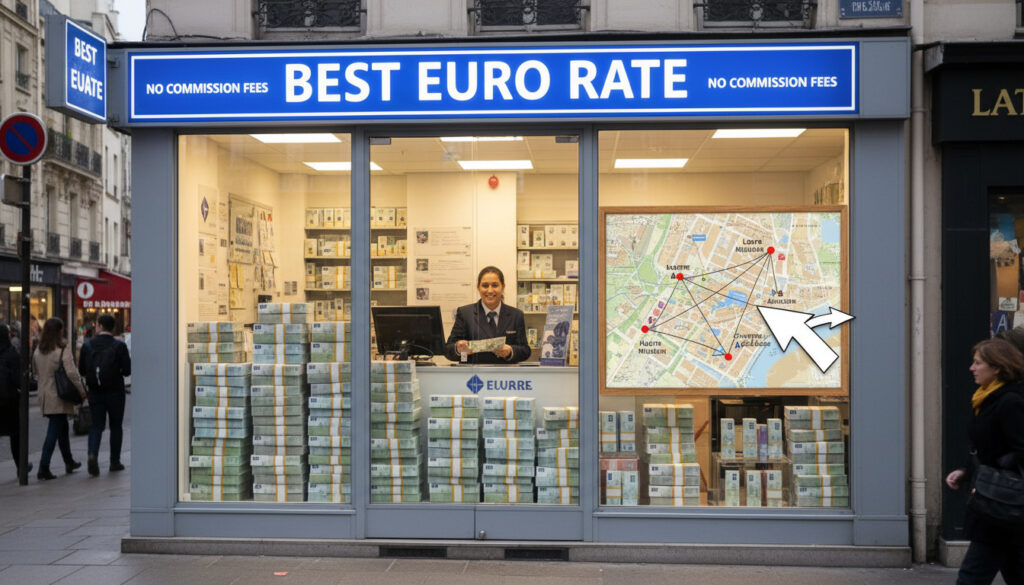
Best Euro Exchange Rate Near Me – Top Local Spots And Tips
Finding competitive euro exchange rates requires understanding how location, timing, and provider type interact. Rates vary significantly between airports, high-street banks, specialist bureaus, and digital platforms, often creating spreads of 10-20% or more for identical transactions.
Local availability plays a decisive role. While major banks maintain branches in most urban centers, specialist foreign exchange providers and fee-free ATM networks offer superior rates with lower overhead costs. Mobile applications now aggregate real-time data from nearby physical locations, allowing immediate comparison before walking into any establishment.
Current market movements add another layer of complexity. The EUR/USD pair recently declined to 1.1416-1.1434 as of March 13, reflecting daily drops of 0.68-0.83% and monthly losses of 3.52%, though maintaining yearly gains of 5.09% according to Trading Economics.
Where Can I Find the Best Euro Exchange Rates Near Me?
Physical proximity no longer dictates pricing efficiency. Three primary categories dominate local markets: high-street banks, specialist currency bureaus, and fee-free ATM networks accessible through modern debit cards.
Specialist FX providers and select bank branches offer competitive physical exchange points.
Real-time apps aggregate current buy/sell spreads from multiple nearby providers instantly.
Hidden commissions and dynamic currency conversion prompts significantly inflate total costs.
Digital platforms bypass physical markup limitations entirely through interbank rate access.
- Specialist providers like Travel FX consistently outperform traditional banks, offering free delivery for orders exceeding £700
- Airport exchange desks routinely apply 10-20% premiums above mid-market rates
- Fee-free debit cards pass through raw Visa, Mastercard, or Amex interbank rates without additional charges
- Location-based comparison tools reveal real-time availability at nearby ATMs and branches
- High-street banks typically embed 2-5% markup within their advertised exchange rates
- Dynamic currency conversion at foreign ATMs adds unnecessary layers of cost
- Digital banks often provide unlimited or high-limit monthly withdrawals abroad
| Provider Type | Avg Spread | Fees | Locations |
|---|---|---|---|
| Specialist Bureaus (e.g., Travel FX) | 0.5-1.5% | Free delivery >£700 | Online/Postal |
| High-Street Banks | 2-5% | Variable transaction fees | Urban centers |
| Airport Exchanges | 10-20% | High fixed charges | Transport hubs |
| Fee-Free ATMs | Interbank rate | None (card dependent) | Global networks |
| Digital Apps (Revolut/Wise) | Interbank + small markup | Low/no foreign transaction fees | Mobile-only |
What Are the Best Places to Exchange Euros?
Established financial institutions and specialist operators occupy different positions on the cost spectrum. High-street banks prioritize convenience over pricing, embedding margins of 2-5% within their standard exchange rates according to financial comparison data.
Banks vs Specialist Bureaus
Traditional banking branches offer immediate liquidity but rarely provide optimal value. Specialist foreign exchange providers operate with lower fixed costs, passing savings to consumers through tighter spreads and promotional delivery options.
The Airport Pricing Trap
Transport hub currency exchanges exploit temporal urgency. Captive market dynamics allow these operators to impose markups reaching 10-20% above mid-market benchmarks, making them suitable only for emergency situations where no alternatives exist.
Airport currency exchanges consistently rank among the most expensive options available, frequently adding margins of 10-20% above interbank rates. Travelers should utilize these services only as absolute last resorts when no other facilities are accessible.
How Do I Get the Best Euro Exchange Rate?
Strategic timing and instrument selection determine final costs more than haggling. Withdrawing larger sums less frequently minimizes per-transaction levies, while declining dynamic currency conversion (DCC) prompts at foreign terminals preserves interbank pricing.
Minimizing Hidden Fees
Fee structures vary by access method. Debit and credit cards bearing zero foreign transaction fees outperform cash advances, while specialized travel cards offer unlimited or high-limit monthly withdrawals abroad without additional charges based on consumer finance research.
ATM Optimization Strategies
Automated teller machines provide competitive rates when accessed through appropriate card products. The key differentiator remains the user’s ability to reject conversion offers presented in their home currency, as these dynamic conversions embed undisclosed premiums.
Withdrawing larger amounts less frequently reduces the impact of fixed per-transaction fees. Always select the local currency option and decline dynamic currency conversion prompts when using foreign ATMs to maintain interbank rate access.
What Currency Exchange Apps and Tools Show Live Rates?
Digital platforms have democratized access to institutional-grade rate data. Applications such as XE, Revolut, and Wise display real-time interbank movements while facilitating comparisons between nearby physical exchange points and delivery options.
Real-Time Market Data
Current forecasts present mixed short-term signals. MUFG Research projects EUR/USD rising to 1.1800 in Q1, 1.2000 in Q2, 1.2200 in Q3, and 1.2400 by Q4 2026, exceeding consensus expectations. Conversely, KeyCurrency analysis identifies immediate downward pressure toward $1.14.
Predictive Analytics
CoinCodex data indicates bullish sentiment for USD/EUR pairs, forecasting rates between €0.9339 and €0.9464 by year-end 2026, representing increases of 6.68-9.57% from current positions around €0.8741. However, consensus among thirty-plus investment banks suggests scaled-back optimism despite general upward trajectory predictions according to Pound Sterling Live.
Trading Economics forecasts EUR/USD reaching 1.16 by quarter-end and 1.18 within twelve months. Cross-pair analysis suggests EUR/GBP maintains mild bullish potential toward 0.90 by Q4 2026, while EUR/CHF remains neutral around 0.95 per ING G10 analysis.
How Have Euro Exchange Rates Moved Recently?
- : EUR/USD trades at 1.1416-1.1434, declining 0.68-0.83% daily and 3.52% monthly despite 5.09% yearly gains (Trading Economics)
- : Short-term bearish sentiment dominates technical indicators, with RSI levels reaching 72.34 indicating overbought conditions
- : MUFG forecasts recovery to 1.2000 as institutional positioning adjusts
- : Continued appreciation expected toward 1.2200 based on interest rate differentials
- : Year-end targets range between 1.18 (consensus) and 1.24 (bullish scenarios)
What Do Rate Predictions Confirm vs. What Remains Uncertain?
| Established Information | Information Remaining Unclear |
|---|---|
| EUR/USD recently fell to 1.1416-1.1434 on March 13, 2026 | Precise timing of recovery above 1.20 resistance levels |
| Banks consistently apply 2-5% markup over interbank rates | Specific fees at unlisted individual ATMs in remote locations |
| Airport exchanges cost 10-20% more than market rates | Exact volatility measurements for next 30-day windows |
| Specialist providers offer free delivery above £700 thresholds | Localized regulatory changes affecting exchange margins |
Why Do Exchange Rates Vary Between Local Providers?
Geographic positioning creates economic friction. Urban centers with multiple competing providers typically offer tighter spreads than rural areas where limited options reduce pricing pressure. Operational overhead significantly impacts final rates—physical storefronts require rent and staffing costs that online specialists avoid.
Network effects also influence accessibility. While 1 Pound in Kg – Exact Conversion and Guide demonstrates precise measurement standards, currency exchange lacks universal pricing. Local bank branches may offer preferential rates to existing account holders, while independent bureaus adjust dynamically based on inventory levels and hedging costs.
What Do Financial Experts Say About Exchange Strategies?
“Specialist FX providers like Travel FX offer competitive rates with free delivery over £700, while debit cards from providers passing through Visa/Mastercard/Amex rates without extra charges represent optimal solutions for frequent travelers.”
— Money.co.uk Travel Money Analysis
“EUR/USD is forecast to reach 1.2400 by Q4 2026, rising from 1.1756 at December 2025 close, with strength building progressively through each quarter as monetary policy divergences narrow.”
— MUFG Monthly Foreign Exchange Outlook
“Avoid airports. Highest markups, up to 10-20% plus fees, make these locations suitable only as last resort options when no alternatives are geographically accessible.”
— Consumer Finance Best Practice Guidelines
How Can I Secure the Best Euro Rate Near Me Today?
Compare specialist providers offering home delivery for amounts exceeding £700, utilize fee-free debit cards accessing interbank rates at foreign ATMs while declining dynamic currency conversion, and avoid airport exchanges entirely. Monitor mobile applications aggregating real-time local rates before visiting physical locations, and consider timing larger exchanges during forecasted strengthening periods as indicated by Spray Tan Near Me – Salons, Costs and Prep Tips proximity logic applies equally to currency searches—local availability requires immediate verification.
Frequently Asked Questions
Does it cost money to exchange currency?
Yes, most providers charge through spreads, fixed fees, or both. Banks typically add 2-5% markup, while airports may charge 10-20% above interbank rates. Fee-free cards and specialist providers minimize or eliminate these costs.
What is the best app for checking live euro exchange rates?
XE, Revolut, and Wise provide real-time interbank rates and local provider comparisons. These apps aggregate nearby physical exchange locations while offering digital transfer options at significantly lower margins than traditional banks.
Is it cheaper to use ATMs or exchange services?
ATMs accessed through fee-free debit cards generally offer superior rates to physical exchange services, provided users decline dynamic currency conversion prompts. Exchange services remain necessary for cash orders and specific delivery requirements.
How often do euro exchange rates change?
Exchange rates fluctuate continuously during market hours. The EUR/USD pair recently moved 0.68-0.83% in a single day. Retail providers may update rates several times daily or apply fixed daily rates depending on their pricing models.
Can I get euros delivered to my home?
Yes, specialist providers like Travel FX offer free delivery for orders exceeding £700. This option typically provides better rates than in-person exchanges while eliminating travel to physical locations.
Should I exchange money before traveling?
Pre-trip exchanges through specialists often secure better rates than airport equivalents. However, carrying fee-free cards for ATM withdrawals abroad provides flexibility without requiring large cash amounts upfront.
What does dynamic currency conversion mean?
Dynamic currency conversion (DCC) allows foreign merchants and ATMs to charge in your home currency rather than the local currency. This convenience hides unfavorable exchange rates and additional fees, significantly increasing total transaction costs.
More related posts
 Stockton-on-Tees Weather: Climate, Monthly Averages, and Forecast
 Live Premier League Table 2024/25 – Current Standings 1 to 20
 Chelsea Lazkani Split and Weight Gain: What We Know
 IKEA Wardrobes: Costs, Quality, and Longevity
 ForChics Hair Growth Oil Spray – Review, Results and Ingredients
 Pride and Prejudice (1995 TV Series) – Cast, Episodes, Where to Watch
 Karisma Kapoor: Marriage, Divorce, Kids, Net Worth & Age Gap
 BBC Weather Market Drayton: 7-Day & 14-Day Forecast Guide