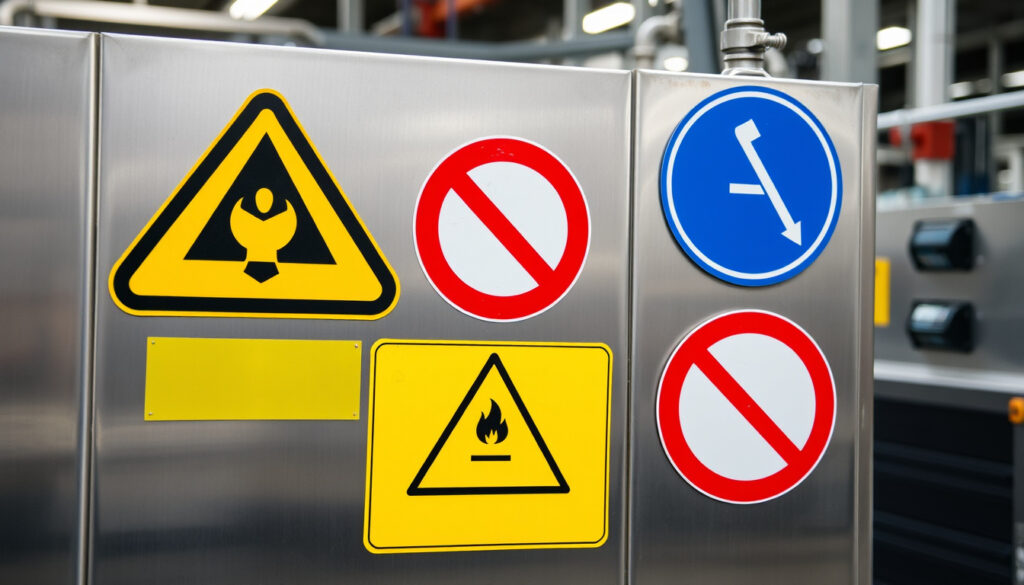
Warning Signs: Examples, Meanings, and Safety Symbols
You see them at construction sites, chemical plants, and even the local grocery store when the floor gets mopped. Those yellow triangles with black symbols are quietly doing a critical job: telling you to stop, look, and think before you proceed. This guide breaks down what warning signs actually mean, from the classic examples you see every day to the more specialized hazard pictograms used in workplaces worldwide.
Standard warning sign shape: Triangle ·
OSHA required sign categories: 4 (Danger, Warning, Caution, Notice) ·
Number of GHS hazard pictograms: 9 ·
Year ISO 7010 published: 2003 ·
Common background color: Yellow with black band
Quick snapshot
- ISO 7010 warning signs are yellow triangles with black borders and black pictograms (UK Health and Safety Executive)
- The US OSHA standard for safety signs is set out in 29 CFR 1910.145 (OSHA safety sign guide)
- Exact number of distinct warning signs worldwide across all standards (Wikipedia: Safety sign)
- Whether specific symbols are universally understood without training (Wikipedia: Safety sign)
- Symbols were introduced more widely to safety signage during the 1990s to overcome language and literacy barriers (Wikipedia: Safety sign)
- Global harmonization continues through GHS pictograms for chemical labeling (GHS pictograms (UN))
“Warning signs are a critical component of workplace safety, alerting employees to potential hazards before they enter an area.” — OSHA safety compliance officer
Six key facts, one pattern: warning signs are a global language designed to be read in a split second. Here’s the quick reference.
| Primary purpose | Alert people to potential hazards |
|---|---|
| Standard color for warning | Yellow with black band |
| Shape for warning signs | Triangle (ISO) or rectangle with triangle (OSHA) |
| Number of GHS pictograms | 9 |
| Regulatory basis (US) | OSHA 29 CFR 1910.145 |
| Regulatory basis (UK/EU) | BS EN ISO 7010 |
What are 7 examples of a warning sign?
Seven warning signs cover the most common workplace hazards, and each one has a standardized look. The UK Health and Safety Executive lists examples that include general danger, drop, low temperature, overhead load, industrial vehicles, and danger: electricity (UK HSE safety signs guidance).
Construction site warning signs
- Falling objects: a pictogram of an object dropping from above
- Overhead load: a fork or crane with suspended load
- Industrial vehicles: a truck silhouette in motion
These signs are common at building sites and warehouses. The UK HSE safety signs regulations require them where vehicles and pedestrians share space.
Workplace chemical hazard signs
- Flammable material: a flame symbol
- Toxic substance: skull and crossbones
- Corrosive: a hand being eaten away by liquid
The 9 GHS hazard pictograms standardize these chemical warnings globally (GHS pictograms from the UN).
Electrical warning signs
- High voltage: a lightning bolt
- Electrical hazard: a lightning bolt with arrow pointing down
ISO 7010 includes the W012 “Warning; Electricity” sign, a black lightning bolt on yellow. These are required near switchboards and substations.
Slip and trip hazard signs
- Wet floor: a person slipping
- Uneven surface: a person tripping
These are the most common in public spaces. They alert people to temporary conditions, not permanent hazards.
Fire warning signs
- Flammable materials: a flame
- Fire extinguisher location: a fire extinguisher pictogram
Fire warning signs tell you where to find equipment, while fire prevention signs tell you what not to do.
Biohazard signs
- Biohazard trefoil: the classic symbol for infectious substances
These appear in labs and healthcare settings, signaling the presence of pathogens (NIOSH signage resources).
Road warning signs
- Curve ahead: a curved arrow
- Pedestrian crossing: a walking figure
- Traffic signals ahead: a traffic light symbol
Road signs follow the same logic as workplace signs: catch the eye, communicate instantly, and prevent an accident.
What are 10 warning signs?
Beyond the basic seven, several other warning signs show up regularly. The pattern: the more specific the hazard, the more specific the symbol. Here are ten that expand the list.
Warning signs by industry
- Explosive material: a bursting bomb
- Corrosive: a hand and surface being eaten
- Harmful irritant: an exclamation mark
Each industry has its own set. Manufacturing needs machinery warnings; logistics needs overhead load signs.
Warning signs for machinery
- Moving parts: a roller or blade in motion
- Crushing hazard: a hand being squeezed
ISO 7010 defines the W023 “Crushing” and W015 “Non-ionizing radiation” symbols. These are often combined with mandatory signs to wear PPE.
Warning signs for confined spaces
- Danger: confined space entry
- Hazardous atmosphere: a gas mask symbol
These signs tell workers that the air might not be safe to breathe, and entry requires a permit.
Warning signs for high temperature
- Hot surface: a hand over a flame
- Low temperature: a snowflake
The HSE example list includes low temperature among its warning signs.
Warning signs for moving parts
- Roller hazard: a cylinder with a hand warning
- Cutting hazard: a blade symbol
Machinery signs prevent amputations and crush injuries — some of the most severe on record.
Warning signs for hazardous atmospheres
- Flammable atmosphere: a flame inside a triangle
- Toxic atmosphere: a skull
These appear near storage tanks and sewers, where gases accumulate.
Warning signs for overhead loads
- Overhead crane: a hook with a load
- Forklift traffic: a forklift silhouette
The HSE requires these in any area where loads move above people.
Warning signs for slippery surfaces
- Wet floor: a person slipping
- Oil spill: a puddle with a drop
Slips are among the most common workplace injuries, so these signs are legally required where spills are likely.
Warning signs for electric shock
- High voltage: lightning bolt
- Static electricity: a bolt with grounding symbol
Warning signs for biological hazards
- Biohazard trefoil
- Biological hazard: a biohazard symbol inside a triangle
The catch: the number of signs a workplace needs depends on its specific risk assessment, not a fixed list.
A single universal sign list doesn’t exist. OSHA and ISO standards each define their own set, and workplaces need a tailored mix to stay compliant.
What do warning signs mean?
Warning signs are designed to communicate a specific message without words, using shape, color, and symbol together. Every element carries meaning.
Purpose of warning signs
- Warn of hazards
- Indicate mandatory actions
- Prohibit actions
- Identify firefighting equipment
- Mark exit routes
Safety signs serve these five functions per the Wikipedia article on safety signs.
Color coding meanings
- Yellow: warning hazard that could cause moderate injury
- Red: danger or prohibition
- Green: safe condition and emergency exits
- Blue: mandatory action
In the US, warning signs often have an orange background in some workplace guidance (Pennsylvania Department of Labor & Industry). This differs from the yellow used in ISO systems.
Shape meanings
- Triangle: warning (ISO 7010)
- Circle: prohibition and mandatory
- Rectangle: emergency information
The triangle shape is universal for warnings. The HSE specifies it must be a black triangle on at least 50% yellow background (UK HSE safety signs).
Text vs pictogram only
- Pictograms: language-independent, standardized since the 1990s
- Text: adds specific details like “high voltage”
- Combination: pictogram plus text for maximum clarity
Symbols were introduced during the 1990s to break down language and literacy barriers (Wikipedia: Safety sign), making safety communication truly global.
What this means: the system is built on visual shorthand, and each design choice — shape, color, symbol — is deliberate and standardized, not decorative.
What are the 9 hazard symbols’ meanings?
The 9 GHS hazard pictograms standardize chemical warnings across the globe. They appear on labels and safety data sheets, ensuring anyone handling chemicals understands the risk (UN GHS pictograms).
Health hazard
- Symbol: a human torso with a star
- Meaning: carcinogen, respiratory sensitizer, reproductive toxicity
Flame
- Symbol: a flame
- Meaning: flammable, self-reactive, pyrophoric
Exclamation mark
- Symbol: an exclamation mark
- Meaning: irritant, skin sensitizer, acute toxicity (harmful)
Corrosive
- Symbol: a hand and surface being eaten
- Meaning: can cause severe skin burns and eye damage
Exploding bomb
- Symbol: a bursting bomb
- Meaning: explosive, self-reactive, organic peroxides
Gas cylinder
- Symbol: a gas cylinder
- Meaning: compressed, liquefied, or dissolved gas
Flame over circle
- Symbol: a flame over a circle
- Meaning: oxidizing agent
Skull and crossbones
- Symbol: a skull
- Meaning: acute toxicity (fatal or toxic)
Environment
- Symbol: a dead tree and fish
- Meaning: hazardous to the aquatic environment
The trade-off: GHS covers chemical hazards only. Biological and physical hazards use different systems, so you cannot rely on one set alone.
What are 10 common safety symbols and their meanings?
Safety symbols go beyond warning signs, covering mandatory actions, prohibitions, and emergency information. Here are ten you’ll encounter regularly.
Safety symbols overview
- First aid: a white cross
- Eyewash station: an eye with a water stream
- Fire extinguisher: a red extinguisher
These are safe condition or fire equipment signs, not warnings per se.
Mandatory action symbols
- Must wear hard hat: a head with a helmet
- Must wear safety goggles: an eye with goggles
- Must wear ear protection: an ear with muffs
These signs are blue circles and tell you what protective equipment is required.
Prohibition symbols
- No smoking: a burning cigarette in a red circle with slash
- No open flame: a flame with slash
- No entry: a red circle with a line through
Warning symbols
- Slippery surface: a person slipping
- High voltage: a lightning bolt
- Laser beam: a light beam
Emergency symbols
- Emergency exit: a running figure through a door
- Emergency shower: a figure under a shower
- Emergency eyewash: a figure with splashing eyes
Fire safety symbols
- Fire alarm call point: a hand pulling a lever
- Fire hose reel: a hose reel
- Fire assembly point: a group of people
Each symbol’s meaning is defined by standards like ISO 7010 or ANSI Z535 (ANSI Z535 standards).
Why this matters: by learning the categories, you can decode any sign — even one you’ve never seen — based on its shape and color. That’s the whole point.
What’s the difference between warning signs and other safety signs?
Warning signs sit in a hierarchy of safety communication. Understanding the difference between “danger,” “warning,” and “caution” can mean the difference between a near-miss and a fatality.
According to ISO 7010, the international standard for hazard symbols, the system divides signs into five categories. The US OSHA system uses four distinct design types, as detailed in OSHA’s 29 CFR 1910.145 guidance.
“Proper signage can reduce the risk of accidents by reinforcing awareness of dangers.” — HSE (UK) safety inspector
Five categories, one logic: the severity of the hazard dictates the design of the sign.
| Sign type | Meaning | Color | Example |
|---|---|---|---|
| Danger | Immediate hazard, death or serious injury if not avoided | Red with black/white | “DANGER – High Voltage” |
| Warning | Potential hazard, serious injury or death possible | Orange (US) or Yellow (ISO) | “WARNING – Flammable” |
| Caution | Potential hazard, minor or moderate injury | Yellow | “CAUTION – Wet Floor” |
| Safety instruction | Required safe practice | Green | “EYE WASH STATION” |
| Prohibition | Action not permitted | Red circle with slash | “NO SMOKING” |
The pattern: if a hazard could kill or permanently injure, it gets “DANGER.” If it’s serious but less immediate, it gets “WARNING.” If it causes minor injury, “CAUTION.”
Using “DANGER” too often dilutes its impact, so safety managers must reserve it for truly life-threatening conditions. Overuse makes workers numb to the signal.
The implication: proper sign classification is a judgment call that requires understanding both the hazard severity and the psychology of the workforce.
Related reading: Paul Merson: Gambling Losses, Family, Arsenal Career · Kate Walsh: Age, Net Worth, Brain Tumor Diagnosis & Career
en.wikipedia.org, safeopedia.com, bravecroc.de, quentic.com, pa.gov, d37iyw84027v1q.cloudfront.net, mitti.com, clarionsafety.com, frrq.cvg.utn.edu.ar, signs.com
Frequently asked questions
Are warning signs legally required in workplaces?
Yes. In the US, OSHA mandates safety signs in 29 CFR 1910.145 (OSHA safety sign guide). In the UK, the Health and Safety (Safety Signs and Signals) Regulations of 1996 require employers to use safety signs where risks cannot be eliminated.
What are the differences between danger, warning, and caution signs?
Danger signs mean immediate hazard with risk of death or serious injury. Warning signs indicate a potential hazard that could cause serious injury or death if not avoided. Caution signs point to hazards that could cause moderate or minor injury. The severity of the risk determines the category.
Do warning signs have to be in English?
No. In the US, OSHA allows symbols that convey the same meaning as text. In ISO-based systems, pictograms are designed to work without words. However, when text is used, OSHA generally expects English. The recommendation is to use both pictograms and text to maximize comprehension.
How often should warning signs be inspected?
There is no universal standard, but industry practice suggests monthly visual inspections and annual certification checks. Signs that are damaged, faded, or obscured must be replaced immediately. The HSE sign guidance stresses signs must remain legible and visible at all times.
What is the penalty for not displaying required warning signs?
In the US, OSHA can fine employers from several hundred to over $15,000 per violation, with repeat offenses costing more. In the UK, HSE enforcement can lead to prosecution and unlimited fines for very serious breaches of health and safety law.
Can warning signs be replaced by verbal instructions?
No. Verbal instructions are not a substitute for permanent signage. ILO safety and health guidance supports the principle that signs are part of a hierarchical system, and verbal briefings complement rather than replace them.
Where should warning signs be placed for maximum effectiveness?
Place signs where the hazard begins, at eye level, in well-lit areas, and directly in the line of sight. Ensure they are unobstructed and use multiple signs for long corridors. The National Safety Council recommends placement at the point of risk, not just at the entrance.
More related posts
 Tranexamic Acid Side Effects – Risks, Symptoms and Safety Guide
 1 Pound in Kg – Exact Conversion and Guide
 Lloyds Pharmacy Near Me: UK Rebrand & Irish Locations
 Big Friendly Giant: Meaning, Movie, Book & Character Guide
 Kerry Godliman: Biography, TV Shows, and Career
 IKEA Wardrobes: Costs, Quality, and Longevity
 Chicken Thighs in Oven: Times, Temps & Crispy Recipe