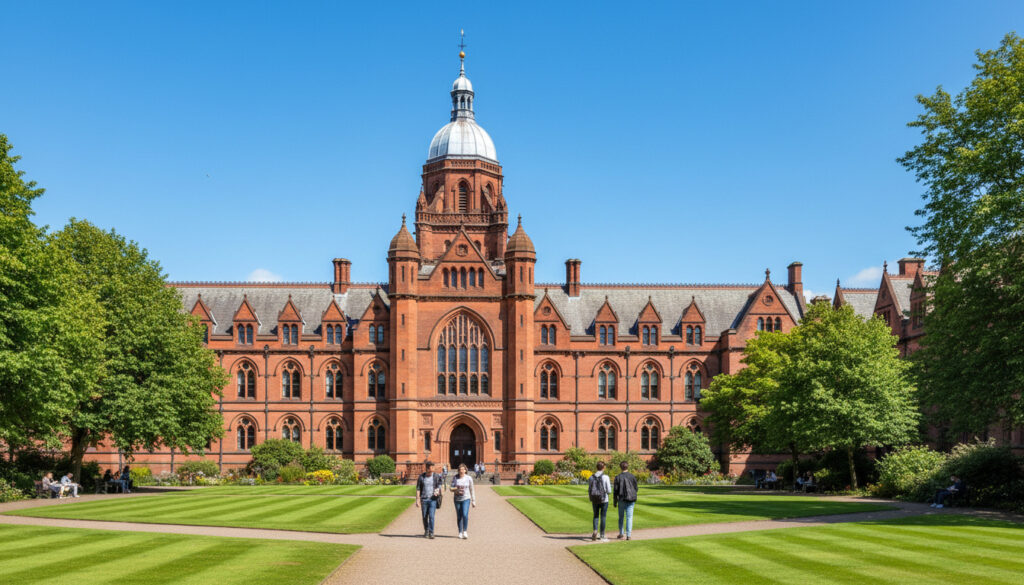
Queens University of Belfast – Verified History and Key Facts
Queen’s University Belfast stands as a major research institution in Northern Ireland with origins dating back to 1845. Established initially as Queen’s College Belfast to broaden higher education access beyond traditional religious boundaries, the institution received its full university charter in 1908 and has since developed into a campus serving over 24,000 students.
The university occupies a prominent position near Belfast’s Botanic Gardens, anchored by the historic Lanyon Building. Documentary evidence confirms its nineteenth-century foundations and significant milestones in chemistry, physics, and parliamentary representation.
History and Founding of Queen’s University Belfast
1845 (University status 1908)
Belfast, Northern Ireland
Over 24,000 students
9th oldest university in the UK
Key Historical Insights
- Established December 30, 1845, as one of three Queen’s Colleges in Ireland alongside Cork and Galway
- Created to provide non-denominational education for Catholics and Presbyterians excluded from Trinity College Dublin
- Opened November 7, 1849, with 23 professors and 195 students
- Architect Sir Charles Lanyon appointed January 1846; selected site near Botanic Gardens
- Granted independent university status December 2, 1908, via Royal Charter signed by King Edward VII
- Rev Thomas Hamilton appointed first President and Vice-Chancellor in 1908
- Maintains non-denominational character continuously since founding
Foundational Facts
| Attribute | Details | Period |
|---|---|---|
| Foundation Charter | December 30, 1845 | Queen’s College established |
| First Lectures | November 7, 1849 | Academic operations begin |
| University Charter | December 2, 1908 | Royal Charter granted |
| First Vice-Chancellor | Rev Thomas Hamilton | 1908 appointment |
| Current Students | Over 24,000 | Recent enrollment data |
| Current Staff | Over 4,200 | Recent employment data |
| Parliamentary Representation | Held seat until abolition | 1950 |
| Quantum Theory Contribution | Bell’s Theorem published | 1964 |
Rankings, Reputation, and Academic Standing
Contemporary assessments of Queen’s University Belfast’s global standing lack specific verification in reviewed documentation. While the institution is frequently referenced within contexts suggesting membership in major UK research consortia, available sources did not contain current ranking metrics or definitive Russell Group status confirmation.
Specific data regarding 2025 university rankings and Russell Group membership are not available in historical records. Prospective students should consult the official university website or Times Higher Education for verified current standings.
What Is Queen’s University Belfast Known For?
Historical records highlight the university’s production of significant academic research, notably physicist John Stewart Bell’s 1964 publication of Bell’s Theorem, considered a foundational development in quantum theory. The institution also held a parliamentary seat alongside seven other UK universities until the practice was abolished in 1950, indicating its long-standing national significance.
Current Rankings and Metrics
Documentation confirms Queen’s status as the ninth oldest university in the UK, but specific contemporary rankings or acceptance rates remain undocumented in available sources. QS World University Rankings and similar aggregator sites may provide current metrics.
Campus Location, Facilities, and Accommodation
The university is situated in Belfast, Northern Ireland, with its main campus located adjacent to the Botanic Gardens. This location has remained consistent since architect Sir Charles Lanyon selected the site in 1846 for the construction of what became the Lanyon Building.
Specific details regarding current accommodation facilities, campus maps, or residential capacity were not available in the reviewed documentation. The physical plant has expanded significantly from its original 1849 footprint, with documented additions including the 1866 library construction and the 1873 gymnasium. Students managing digital tasks on campus devices may find productivity guides such as How to Split Screen on iPad relevant for multitasking during studies.
Where Is Queen’s University Belfast Located?
Queen’s University Belfast is located in Belfast, Northern Ireland, United Kingdom. The campus sits near the Botanic Gardens, a location selected in 1846 that continues to define the university’s physical presence.
Accommodation and Facilities
While historical records document the 1866 library construction (now The Graduate School), the 1873 gymnasium erection, and the 1894 opening of Chemical and Pharmaceutical Laboratories, current accommodation specifics and facility inventories require direct verification with the university housing office.
Courses Offered and How to Apply to Queen’s University Belfast
Specific course catalogs, medicine acceptance rates, and detailed application procedures for 2025 entry were not contained in the available source materials. The university offers undergraduate and postgraduate programs, but comprehensive listings require direct consultation with admissions portals.
For current course listings and application deadlines, prospective students should consult UCAS and the Queen’s University Belfast official admissions office. These sources maintain updated entry requirements and international student policies not available in historical documentation.
Available Courses and Programs
The 1921 establishment of the Faculty of Applied Science and Technology and the 1922 introduction of agricultural research indicate long-standing strengths in applied sciences. However, current course availability, including medicine and law programs frequently referenced in search queries, must be verified through official channels.
Application Procedures
Standard UK university application procedures apply, typically requiring submission through the UCAS system for undergraduate programs. Specific entry requirements, documentation needs, and deadline dates for 2025 entry were not available in the reviewed sources.
Tuition Fees and Costs to Study at Queen’s University Belfast
Specific tuition fees for UK, EU, and international students, along with scholarship availability and living cost estimates, were not documented in the reviewed sources. Financial information varies significantly by program and student residency status, requiring direct verification.
Current tuition rates and fee structures are not available in the provided documentation. Students should consult the UK government student finance pages and the university’s official bursary office for 2025 entry costs.
Undergraduate and Postgraduate Fees
Fee structures typically differentiate between home/EU and international student status, with variations between classroom-based and laboratory-based programs. Exact figures for 2025 academic year enrollment require confirmation through the university’s financial services department.
Development Timeline of Queen’s University Belfast
- : Charter granted for Queen’s College Belfast as part of the Queen’s University of Ireland
- : Sir Charles Lanyon appointed architect; site selected near Botanic Gardens (Source)
- : College opens with 23 professors and 195 students
- : First major expansion; new library constructed (now The Graduate School)
- : Campus gymnasium erected
- : First Chemical and Pharmaceutical Laboratories opened
- : Students’ Union building stone-laying ceremony
- : Royal Charter signed by King Edward VII; independent university status established (Source)
- : Faculty of Applied Science and Technology established
- : Agricultural research introduced
- : Parliamentary seat abolished (Source)
- : John Stewart Bell publishes Bell’s Theorem
Verified Historical Data
The institution’s foundational records establish that Queen’s College Belfast opened on November 7, 1849, following its chartering on December 30, 1845. It received independent university status through a Royal Charter signed by King Edward VII on December 2, 1908. As the ninth oldest university in the UK, it has maintained a non-denominational character since its establishment and currently serves over 24,000 students with a staff exceeding 4,200.
Notable achievements include physicist John Stewart Bell’s 1964 publication of Bell’s Theorem, a fundamental contribution to quantum theory, and the university’s historical parliamentary representation, shared with only seven other UK institutions until the practice ended in 1950.
Current prospective students should note that specific 2025 rankings, Russell Group membership status, detailed tuition fees, medicine acceptance rates, accommodation specifications, scholarship offerings, and application deadlines require direct confirmation with university officials.
Academic and Historical Context
Queen’s occupies a distinctive position within UK higher education as the ninth oldest university, predating many contemporary research institutions. Its 1845 foundation specifically addressed religious exclusion in Irish higher education, offering an alternative to Trinity College Dublin’s then-Anglican exclusivity by welcoming Catholics and Presbyterians.
The institution’s development parallels Northern Ireland’s industrial and political evolution, from the nineteenth-century expansion of chemical and pharmaceutical laboratories to the 1921 establishment of applied science faculties. The 1908 transition from college to independent university marked its emergence as a degree-granting authority separate from the Royal University of Ireland system.
Academic contributions include fundamental advances in quantum physics through Bell’s Theorem, while the university’s historical parliamentary representation reflects its longstanding national significance. This legacy continues in its current scale, serving over 24,000 students with a staff exceeding 4,200.
Historical Documentation and Attribution
Queen’s College Belfast opened in 1849 with 23 professors and 195 students, with lectures beginning on November 7.
— Queen’s University Belfast Special Collections
The Royal Charter founding Queen’s University of Belfast was signed by King Edward VII on December 2, 1908.
— Queen’s University Belfast 180 Timeline
Physicist John Stewart Bell published Bell’s Theorem in 1964—considered one of the most significant developments in quantum theory.
— Queen’s University Belfast Historical Records
Summary
Queen’s University Belfast represents a historic research institution founded in 1845 and chartered as a university in 1908. With over 24,000 students and 4,200 staff, it operates from its Belfast location near the Botanic Gardens, maintaining the non-denominational character established at its founding. While its historical significance—including contributions to quantum physics and parliamentary representation—is well-documented, prospective students must consult UCAS and the university directly for current rankings, fees, and admission standards. Those managing their application preparation might also find technical guidance such as How to Fix Slow Startup Windows useful for ensuring reliable computer performance during the submission process.
Frequently Asked Questions
Who founded Queen’s University Belfast?
Queen’s College Belfast was established by royal charter on December 30, 1845, as part of the Queen’s University of Ireland. Rev Thomas Hamilton became the first President and Vice-Chancellor when it achieved independent university status in 1908.
Is Queen’s University Belfast a public university?
Historical records indicate it was established as a state-recognized institution receiving royal charters. Current governance structure and public/private status details require verification with official university documentation.
What is the Lanyon Building?
The Lanyon Building is the main structure of Queen’s University Belfast, designed by architect Sir Charles Lanyon who was appointed in January 1846. It remains the university’s iconic central building.
How old is Queen’s University Belfast?
Founded in 1845, Queen’s is the ninth oldest university in the UK. It operated as Queen’s College Belfast for 63 years before receiving its independent university charter in 1908.
What was Queen’s College Belfast?
Queen’s College Belfast was the original name of the institution founded in 1845. It operated under this name until 1908 when the Irish Universities Act established it as an independent university.
Does Queen’s University Belfast offer distance learning?
Current information regarding online course offerings, distance learning programs, or remote study options was not available in the reviewed sources. The university should be contacted directly for current modality options.
Is Queen’s University Belfast accredited?
The institution holds a Royal Charter granted in 1908, constituting its degree-awarding authority. Current specific accreditation status for individual programs requires verification with the university or relevant professional bodies.
More related posts
 How to Split Screen on iPad – Complete Guide for All Models
 Strictly Christmas Special 2025 – Winner, Cast, Hosts Guide
 DWP Cost of Living Payment 2025 May – No Payments Planned, Alternatives
 Woodland Walks Near Me: Best Forest Trails in Ireland
 iPhone 15 Pro Max Price: Ireland, UK Deals & Trade-In Value 2026
 How to Cook Corn on the Cob: 6 Best Methods Tested
 Pain in Right Hip Area in Females: Causes & When to Worry
 Get a Load of This Guy: Meaning, Origin, Memes, TikTok